← Все материалы

ИИ-реклама за 1$, 100$ и 1000$: видео с нейросетью

Вы снимаете три коротких видео: в каждом в руках другое блюдо и одна фраза — «вот такое видео делают за 1 доллар», потом за 100, потом за 1000. ИИ продолжает каждое видео с его последнего кадра и делает рекламу: за 1$ — простую, за 100$ — студийную, за 1000$ — как в кино. Шаги и 3 готовых промпта — ниже; полное руководство (глоссарий, таблица уровней, ошибки и их причины) — в PDF.

Хотите научиться системно? Мини-курс

Материалы

Пошагово

  1. Шаг 1 · Камера

    Снимите хуки и разберите их

    Снимайте все три хука в одном месте и в один день: одинаковый свет и одежда превращают три видео в одну серию. Держите блюдо на уровне груди, повернув к камере, — именно из этого кадра ИИ узнаёт, какое оно. Фраза должна быть по одному шаблону, меняется только цена — так зритель сразу понимает сравнение. Последние полсекунды не двигайтесь: рука на месте, блюдо видно — этот кадр станет первым кадром рекламы. Затем разберите каждый хук покадрово — не угадывайте, всё измеряйте: длительность и fps, таблица кадров каждые 0,2 секунды (contact sheet), что внутри блюда и фраза в хуке. То, чего не видно, не придумывайте — спросите у владельца блюда.

    Совет: Почему именно последний кадр: если реклама начинается с последнего кадра хука, в монтаже не видно склейки — зритель видит, как тот самый лаваш из рук сам взлетает в воздух. Это даёт ощущение «магии за один доллар», и в этом главный трюк серии.

  2. Шаг 2 · Монтаж · Seedance

    Подготовьте start frame

    В монтажной программе встаньте на самый последний кадр хука и сохраните его в PNG через «export frame». В Seedance загрузите изображение именно в поле start frame / first frame — в промпте оно называется @image1. Если в рекламе блюдо должно быть другим (например, говядина вместо курицы), сначала замените в редакторе изображений только эту часть и пропишите, что всё остальное не трогать.

    Совет: Осторожно: в первой попытке уровня 1000$ изображение попало не в start frame, а в обычный референс. Модель построила первый кадр сама: парень в другой позе, голова обрезана кадром, связь с хуком нарушена. Перед генерацией проверьте, в каком поле стоит изображение.

  3. Шаг 3 · Уровни

    Разведите уровни

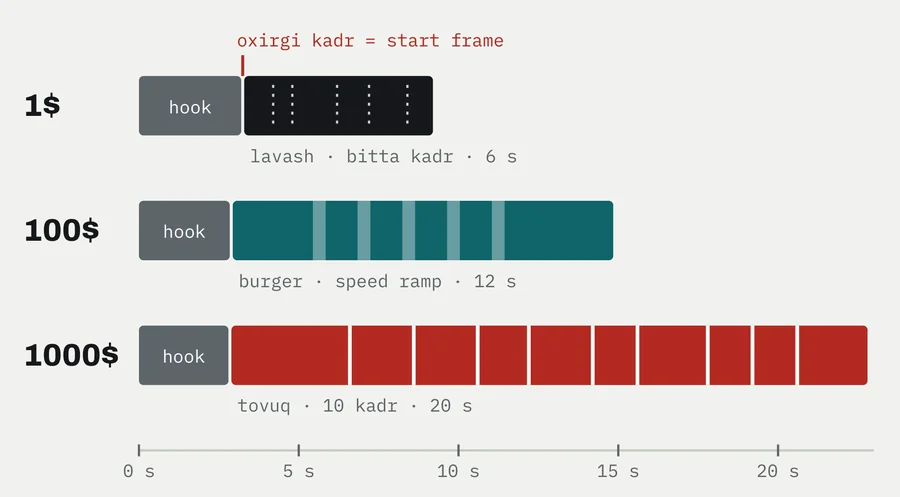
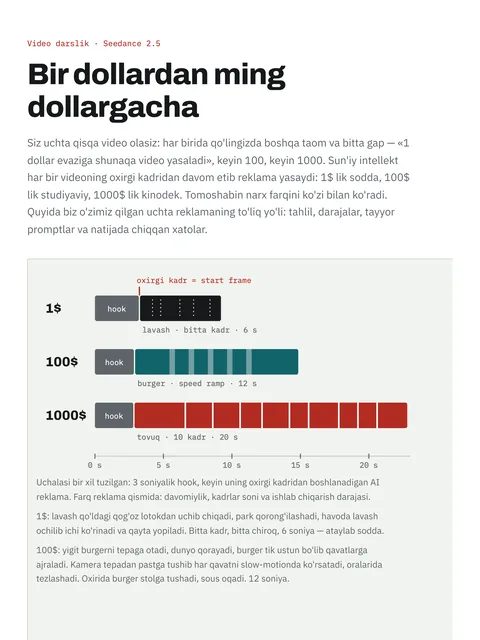
    Серия работает, только если разница видна. Каждый следующий уровень — не «больше эффектов», а совсем другая лига. 1$ — 6 секунд, один непрерывный кадр, один прожектор, медленное движение: лаваш поднимается, раскрывается, видна начинка, и снова закрывается. 100$ — 12 секунд, один непрерывный кадр со speed ramp; студия: три источника света, чёрный фон, камера опускается по слоям; бургер раскладывается на слои, каждый слой в slow-motion, в конце стекает соус. 1000$ — 20 секунд, 10 кадров со склейками; макрообъективы, столбы света, дым, малая глубина резкости: от удара мир темнеет, процесс готовки показан от начала до конца.
    Разведите уровни

    Совет: 1$ намеренно простой: красивый, но не слишком крутой — иначе рост к 100$ и 1000$ не почувствуется. Делайте это простотой, а не плохим качеством: один кадр, один свет, без брызг, без макро. Не просите модель «сделать хуже» — уменьшайте количество элементов.

  4. Шаг 4 · Seedance 2.5

    Напишите промпт

    Промпт — это техническое задание, разбитое на блоки: SCENE CONTEXT, ACTIVE REFERENCES, FIRST FRAME, FORMAT, CAMERA, ACTION, блок блюда (FILLING, LAYERS или THE CHICKEN PIECES), SIZE AND POSITION, PHYSICS, LIGHTING, AUDIO, OUTPUT SETTINGS и POSITIVE LOCKS. Пишите промпт на английском — модель понимает его точнее. Привяжите каждое событие к конкретной секунде и добавьте фразу «each beat is triggered by its timestamp alone» — без неё модель ждёт позу или звук и запаздывает. 3 промпта ниже — финальные версии после исправления ошибок первых результатов: скопируйте и подставьте своё блюдо, героя и место.

    Совет: Эти промпты длинные — от 6 до 10 тысяч символов. В Seedance 2.5 у нас работали промпты такой длины. Если генерация выдаёт «failed», сократите повторяющиеся описания.

  5. Шаг 5 · Seedance 2.5

    Сгенерируйте и проверьте

    Проверяйте результат вместе с хуком, поставив его рядом с оригиналом на тех же секундах: совпадает ли первый кадр с последним кадром хука; то ли это блюдо — число слоёв, вид мяса, форма кусочков как в промпте; происходят ли события на указанной секунде; показан ли каждый этап или модель какой-то пропустила; достаточно ли блюдо крупное в кадре и видна ли текстура; то же ли лицо у парня, что в хуке; нет ли в кадре лишнего — надписей, бликов, посторонних объектов.

    Совет: Seedance 2.5 на многих платформах выдаёт максимум 720p. Если результат вышел в 720p, это ограничение модели, а не ваша ошибка.

  6. Шаг 6 · Промпт

    Найдите ошибку и запишите причину

    «Модель не сделала» — это не ответ. Почти каждая ошибка идёт из конкретной строки промпта. Например, на уровне 100$ в собранном бургере вдруг появились говяжья котлета и сыр: слои были перечислены в отдельном блоке, а в моменте сборки сказано только «one burger». Если слово «burger» остаётся одно, модель рисует классический чизбургер. Исправление: заново перечислить состав в моменте сборки и в последнем кадре, лишнее запретить по названию — no cheese, no second patty. Другие случаи из нашей серии и их исправления — в PDF-руководстве.

    Совет: Когда остановиться: если одна и та же ошибка повторяется дважды, виновата не строка, а подход. Возможно, вы просите то, что противоречит природе модели, — например, раскладывать слои горизонтально. Тогда переходите на её естественное направление.

  7. Шаг 7 · Монтаж

    Соедините в монтаже

    Поставьте хук на первую дорожку и приклейте ИИ-рекламу к его концу — start frame один и тот же, поэтому склейки не видно. Звук хука берите из оригинала, звук рекламы оставьте — в нём только эффекты. Музыку положите в конце на всё видео: в промптах музыки намеренно нет, музыка от модели конфликтует с эффектами. Надписи «1$», «100$», «1000$» тоже добавьте в монтаже: в промптах надписи запрещены — текст, нарисованный ИИ, часто выходит искажённым. Выпускайте три видео по отдельности или одним роликом подряд — подряд рост виден ещё ярче.

    Совет: Пусть серия будет цельной: все три рекламы по одному шаблону — хук, реклама с его последнего кадра, в конце блюдо снова в руке героя. Зритель узнаёт шаблон и сравнивает только уровень.

Главные правила

  • Не боритесь с моделью. Она разбирает бургер сверху вниз, двигает человека, расширяет кадр — пишите с учётом этих привычек.
  • Не оставляйте название блюда одно. Не «Burger», а: a beef burger with a single beef patty, no cheese.
  • Каждый уровень должен отличаться одной чёткой вещью: числом кадров, светом или масштабом.
  • Описывайте ощущение звуком. «Резко» — тяжёлый удар перед тишиной. «Роскошь» — тишина и чёткие звуки крупным планом: шипение, хруст, капля.
  • Всегда проверяйте результат рядом с оригиналом. Смотреть только на результат недостаточно: разница в размере и положении видна именно так.
  • Сохраняйте понравившиеся варианты — следующая попытка может выйти хуже.
  • Подставьте в промпты своё блюдо, героя и место — структура и замки не меняются.
Полное руководство (PDF)Открыть
1$ — лаваш, 6 секунд, один кадр

LAVASH — 1$ CINEMATIC AD — one continuous shot, 6 seconds SCENE CONTEXT A young man sits at a blue wooden table in a sunny park, holding a grilled chicken lavash in a white paper tray at chest height. The lavash shoots up out of the tray by itself, the sunny park fades into a dark studio void lit by one warm spotlight, and while floating the lavash unrolls to show its filling, then rolls itself closed again. ACTIVE REFERENCES @image1: the exact first frame of this video, 100% matching the reference — the young man in a grey t-shirt, the white paper tray in his two hands, the park, the red food truck behind him. The lavash in @image1 is the hero of the whole video: a soft wheat flatbread rolled into a closed log, pale golden, with toasted diagonal grill stripes across its top. The same lavash with the same grill stripes appears from the first frame to the last. FIRST FRAME Identical to @image1: vertical medium close-up, the man centred, the tray with the lavash held at chest height, right of frame centre, lying diagonally. FORMAT One continuous shot. The camera never cuts. CAMERA Neutral 47° lens, smooth stabilized movement, the lavash always in sharp focus. 0.0–1.0s: the camera cranes up quickly together with the rising lavash, keeping it in frame and easing it to the centre. The man slides out of the bottom edge of frame as the camera rises and is fully gone by 0.9s. 1.0–1.6s: the camera settles, lavash centred. 1.6–3.0s: the camera eases back a little, just enough that the whole opened lavash fits inside the frame with dark space around it. 3.0–6.0s: slow steady push-in at about 1 km/h toward the centre of the lavash. ACTION — each beat is triggered by its timestamp alone, never by a pose or a sound 0.0–1.0s THE MAN: holds completely still for as long as he is in frame, like a paused photograph — the exact pose, face, eyes, mouth, hands and expression of @image1. He keeps his gaze exactly where it is in @image1, stays silent, and his hands keep holding the empty tray exactly where it is. He makes no movement of his own of any kind: no look up, no blink, no head turn, no reaction, no gesture. LAVASH: lifts out of the tray and shoots straight up in one quick, confident rise — a fast start, peak speed about 3 km/h, then a soft stop — about half a metre, to above the man's head height, turning to lie horizontal, long side left to right. The empty tray stays in his hands. 1.0–1.6s LAVASH: hovers in the spotlight, slowly rotating a quarter turn so the grill stripes catch the light. 1.6–3.0s LAVASH: unrolls like a scroll opening from its outer edge and flattens into an open round flatbread, tilted about 45° toward the camera so its inside faces the lens. The filling it was wrapped around is revealed across the centre of the open bread. As it opens, the filling pieces lift a finger's width above the bread and float in one loose layer, slowly turning, each ingredient separate and clearly readable. Thin steam rises from the chicken. 3.0–4.0s LAVASH: holds open, drifting slowly, the filling floating calmly above it. 4.0–5.2s LAVASH: the filling settles back onto the bread, and the bread rolls itself closed — the exact reverse of the opening — back into the same closed log with the same grill stripes as at the start. 5.2–6.0s LAVASH: floats closed and centred in the spotlight, turning slowly, a soft glint of light sliding across the grill stripes. Holds to the end. FILLING — exactly these six, clearly visible while open Grilled chicken strips with golden-brown charred edges · golden crispy french fries · fresh red tomato slices · fresh green cucumber slices · shredded crisp green lettuce · a thick glossy stripe of creamy white garlic sauce. SIZE AND POSITION Closed lavash while floating: about half the frame width, centred, its full length visible. Open lavash: about 80% of the frame width, entirely inside the frame with dark space on all sides. PHYSICS The flatbread is soft, flexible wheat bread a few millimetres thick — it bends and curls softly, with visible bread texture and toasted spots. The quick rise has real momentum and a soft settle at the top; after that the floating is calm and steady, as if weightless. The sauce stays as one thick glossy stripe on the chicken. Every filling piece keeps its shape and returns inside the bread when it closes. LIGHTING 0.0–0.4s: the bright midday daylight of @image1. 0.4–1.4s: the daylight dims down quickly like stage lights going out; trees, sky, food truck and table sink into darkness. From 1.4s: a dark warm brown-black void with thin haze at 15% density. One warm spotlight at 3200K from above and slightly in front lights the lavash; a soft warm rim light from behind outlines its edges. The lavash is lit only by this spotlight. A few warm dust specks drift slowly through the beam. AUDIO No voice, no dialogue, no music. Sound effects only: a quick sharp airy whoosh as the lavash shoots up (0.0–0.4s); a low soft bass swell as the lights dim (0.4–1.4s); a soft bread flap and a gentle sizzle as it unrolls (1.6–3.0s); a soft reverse whoosh as it rolls closed (4.0–5.2s); one soft low hit at 5.2s. STYLE Photoreal, clean and simple commercial look: one continuous take, one light, calm motion after the quick rise. Real appetising food texture. The frame contains only the scene — no text, captions, logos or graphics are added. OUTPUT SETTINGS Vertical 9:16, 1080×1920, 25 fps, 6 seconds, real-time speed throughout. POSITIVE LOCKS — The first frame is @image1 exactly. — The man is a completely still, frozen figure — identical to @image1 in every frame he appears in — and he appears only until 0.9s, then is fully out of frame for the rest of the video: no hand, no shoulder, no hair anywhere after that. — The paper tray stays in the man's hands and leaves the frame with him. — The same lavash, same colour, same grill stripes at the start and at the end. — Exactly six fillings, all readable while the lavash is open. — The lavash stays centred and keeps the sizes set above. — One continuous shot, no cuts, no added text.

100$ — бургер, 12 секунд, speed ramp

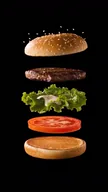
BEEF BURGER — 100$ CINEMATIC AD — one continuous camera move with speed ramps, 12 seconds SCENE CONTEXT A young man sits at a table in a sunny park, holding an open red burger box with a burger toward the camera. He flicks the box upward and the burger launches straight up into the air; the world behind goes black, and at the top of its flight the burger comes apart into a vertical column of floating layers lit by studio lamps. The camera travels down the column from the top bun to the bottom bun — slow motion on each layer, a quick speed-up between layers. The layers then drop back together into one burger, which falls onto a wooden tabletop under a warm lamp, and creamy white sauce runs slowly down its side. ACTIVE REFERENCES @image1: the exact first frame of this video, 100% matching the reference — the young man in a grey t-shirt, the red box with white interior in his hands, the park and the food truck behind him. @image1 also supplies the burger's golden sesame-seed bun, its size and its overall look. One deliberate difference from @image1: the meat inside this burger is a thick, juicy grilled beef patty. Wherever the meat is seen in this video, it is that beef patty. FIRST FRAME Identical to @image1: vertical medium close-up, the man in the centre smiling, the open red box with the burger held at chest height, right of frame centre. FORMAT One continuous shot — the camera moves without a single cut. The pace changes only through speed ramps: stretches of slow motion joined by short bursts of fast motion. CAMERA Neutral 47° lens for the opening, tighter 29° framing for the layer close-ups. Smooth stabilized movement; the burger, or the current layer, is always in sharp focus. 0.0–0.5s: slow dolly back of about 30 cm, real time. 0.5–1.8s: the camera cranes up quickly, following the burger as it flies upward. The man slides out of the bottom edge of frame and is fully gone by 1.2s. 1.8–2.6s: the camera holds on the whole floating column, all five layers in frame. This wide view lasts only until 2.6s. 2.6–3.0s: a quick push-in to the top bun. 3.0–9.6s: the camera travels downward along the column, from the top bun to the bottom bun, a little above each layer and looking down at it at about 25° so each layer's top surface is clearly visible — a slow creep across each layer, then a quick downward rush with motion blur to the next one, then easing back into a slow creep. It physically travels down the column; it never swings on the spot and never cuts. 9.6–10.4s: the camera pulls back to see the whole reassembled burger and follows it down to the table. 10.4–12.0s: slow push-in toward the burger on the table, the camera level with the burger. ACTION — each beat is triggered by its timestamp alone 0.0–0.5s THE MAN: holds the box exactly as in @image1, same smile, face identical to @image1. 0.5–1.0s THE MAN: flicks the open box upward with one quick motion of his hands, then stays still, the empty box staying in his hands. His face stays identical to @image1. BURGER: launches straight up out of the box, rising high above the man's head. BACKGROUND: from the instant of the flick, the park, the food truck and the man begin to sink into black. 1.0–1.8s — slow motion begins at 1.2s BURGER: keeps rising, slowing toward the top of its flight. At the top of its flight it comes apart into its layers, and the layers spread apart vertically into one straight column, each layer lying level and flat, floating one above another with a clear gap between neighbours, in this exact order from top to bottom: top bun, beef patty, lettuce, tomato, bottom bun. The studio lamps come on and light the column. 1.8–2.6s — slow motion: the whole column floats in the light; sesame seeds lift off the top bun and drift. 2.6–3.0s — speed ramp: fast push-in to the top bun. 3.0–4.0s — slow motion: TOP BUN. Glossy golden dome covered in sesame seeds, a few seeds lifting off and drifting slowly through the light. 4.0–4.4s — speed ramp: fast downward rush to the next layer. 4.4–5.4s — slow motion: BEEF PATTY. A thick, juicy grilled beef patty with a dark seared crust and grill char, its surface glistening with juices, a few drops of juice hanging in the air, a wisp of steam rising. 5.4–5.8s — speed ramp. 5.8–6.8s — slow motion: LETTUCE. A ruffled bright green leaf coated with a thick layer of creamy white sauce, a few water droplets floating off its edges. 6.8–7.2s — speed ramp. 7.2–8.2s — slow motion: TOMATO. Two red tomato slices, glistening cut faces showing their seeds, small juice droplets drifting off. 8.2–8.6s — speed ramp. 8.6–9.6s — slow motion: BOTTOM BUN. Toasted golden cut face with soft crumb texture. 9.6–10.4s — real-time speed: the layers drop back down onto one another, top to bottom, and snap into one burger: top bun, beef patty, lettuce with sauce, tomato, bottom bun. The whole burger falls at moderate speed onto a wooden tabletop and lands at 10.4s with a small soft bounce; a few sesame seeds hop on the wood. Nothing is attached to the burger as it falls — clean empty air below it. 10.4–12.0s — gentle slow motion: the burger sits on the table under the lamp. Creamy white sauce oozes out from between the layers and runs slowly down its side, one thick glossy drip falling onto the wood. Holds to the end. LAYERS — exactly these five, in this order, from the moment the burger leaves the box to the last frame Top sesame bun · one beef patty · lettuce with white sauce · tomato slices · bottom bun. This is a beef burger with a single beef patty. It contains no fried chicken, no cheese, no onion, no second patty and no extra bun — in the floating column, in the reassembled burger and in the final shot alike. SIZE AND POSITION Opening: framing identical to @image1. Wide column view (1.8–2.6s): the whole column centred, about 75% of the frame height, fully inside the frame. Layer close-ups: each layer, at its slow-motion moment, is centred and about 80% of the frame width, fully inside the frame. Final shot: the whole burger centred in the lower half of the frame, about 60% of the frame width, inside the lamp's pool of light. PHYSICS The burger's upward flight has real momentum: fast at launch, slowing as it nears the top. In slow motion everything moves smoothly and continuously — seeds, juice drops, water droplets and steam drift with real weight. In the ramps motion speeds up about four times with natural motion blur, then eases back. The bun is soft and springy, the beef patty dense and juicy, the lettuce thin and flexible, the tomato wet and heavy. The sauce is thick and creamy: it flows slowly and clings to the burger. LIGHTING 0.0–0.5s: the bright midday daylight of @image1. 0.5–1.3s: the daylight drops away and the world behind goes fully black by 1.3s. From 1.3s: studio lamp lighting on a pure black background with thin haze at 10% density — a warm key light at 3200K from the upper left, a strong warm rim light from behind that outlines every edge and makes sesame seeds, juice drops and droplets sparkle, and a soft fill from the front. The burger is lit only by these lamps. Final shot: one warm pendant lamp hangs at the top edge of the frame above the table, casting a round pool of warm light on the wood and the burger; everything outside the pool falls to black. AUDIO No voice, no dialogue. A low, minimal cinematic pulse runs underneath from 0.5s. Sound effects: a quick upward whoosh as the burger launches (0.5s); a deep bass drop as the world goes black (0.8s); a stretched low rumble whenever time slows; a sharp fast whoosh on every speed ramp; a soft airy shimmer with tiny seed ticks on the top bun; a rich meaty sizzle on the beef patty; a crisp leaf rustle and droplet plinks on the lettuce; a wet juicy drip on the tomato; a soft toasty thump on the bottom bun; a fast layered whoosh and a satisfying stacked thump as the burger reassembles (10.0s); a solid wooden knock as it lands (10.4s); a slow creamy drip as the sauce runs (10.9s onward). STYLE Photoreal high-end food commercial: rich appetising textures, deep blacks, warm glowing highlights, crisp detail. The frame contains only the scene — no text, captions, logos or graphics are added. OUTPUT SETTINGS Vertical 9:16, 1080×1920, 25 fps, 12 seconds. Real time 0.0–1.2s and 9.6–10.4s; slow motion on each layer; short fast ramps between layers; gentle slow motion 10.4–12.0s. POSITIVE LOCKS — The first frame is @image1 exactly. — The man appears only until 1.2s; after that nothing of him is visible. The empty box stays in his hands and leaves the frame with him. — The burger flies straight up, and its layers form one vertical column, each layer level and flat, in this order from top to bottom: top bun, beef patty, lettuce with white sauce, tomato, bottom bun. — The camera visits every one of the five layers in that order, top to bottom, each with its own slow-motion close-up. — The wide column view ends at 2.6s. — A single beef patty is the only meat — no chicken, no cheese, no extra layers anywhere, including the reassembled burger and the final shot. — One continuous camera move, no cuts; the pace changes only through speed ramps. — Pure black background from 1.3s to the end, except the lamp and its pool of light in the final shot. — No added text or graphics.

1000$ — жареная курица, 20 секунд, 10 кадров

FRIED CHICKEN — 1000$ CINEMATIC AD — 20 seconds, 10 shots SCENE CONTEXT A young man at a blue wooden table in a sunny park, in front of a red food truck, lifts a paper bucket of crispy fried chicken and slams it down on the table. The blow is so powerful that its shockwave blows the whole world behind him out into black. The chicken blasts up into the darkness, its crust falls away and the pieces turn raw — and the whole cooking process plays out again in slow-motion macro detail: marinade, spices, flour, golden oil, the crispy crust and the crunch. The finished pieces land back in his bucket in the park at night. ACTIVE REFERENCES @image1: the exact first frame of this video, 100% matching the reference — the young man, his beige t-shirt, the paper bucket of crispy fried chicken, the blue wooden table, the park and the red food truck. The chicken in @image1: crispy fried chicken tenders — long, flat, irregular strips with a rough, craggy golden-brown breading. In the final shot the man, the bucket, the chicken and the food truck match @image1 again. THE CHICKEN PIECES Long, flat, irregular strips of chicken breast — every piece a different length, width and shape, like hand-cut tenders. Never teardrop-shaped, never drumsticks, never nuggets, never identical copies. Whenever several pieces are in frame, they float at different depths and angles in a loose, irregular scatter — never a neat symmetrical cluster. SHOT 1 — 0.0–3.8s — THE SLAM (one continuous take) 0.0–0.6s: first frame identical to @image1. The camera dollies back fast, about 80 cm. The man still holds the bucket exactly as in @image1. 0.6–1.8s: he takes the bucket in both hands and lifts it up to head height with a determined grin; at the same time the camera pushes in fast toward the bucket until the bucket and his hands fill the centre of the frame, about half the frame width, his face just above it. At the top of the lift, from 1.6s to 1.8s, everything holds still for an instant. 1.8–2.2s: he drives the bucket down hard; the camera pulls back fast to a waist-up framing, the table top across the bottom third of the frame. 2.2s — IMPACT: the base of the bucket hits the table. A short, hard camera shake. The image ramps into slow motion. 2.2–3.8s — slow motion: a ring of dust and golden crumbs rolls outward across the table top and the planks jolt. A transparent ripple of air pressure expands outward from the bucket, bending the image as it travels, and everything behind the man that it passes — the trees, the sky, the food truck, the whole park — is blown out into pure black, as if his blow knocked the light out of the world. By 2.8s the background is completely black. Only the man, the table and the bucket remain, now lit by a single hard warm light from above. The chicken bursts up out of the bucket; dust and crumbs hang in the air, glowing in the light; his hair lifts slightly. The impact is purely physical — dust, crumbs, air and motion — with no glow and no light orbs. His face stays identical to @image1 throughout. SHOT 2 — 3.8–5.8s — RAW Macro, 100mm lens, very shallow depth of field, super slow motion, black void, one narrow shaft of warm light from above. One piece rises into the frame and fills most of it; its golden crust cracks along fine lines and flakes away piece by piece, the flakes crumbling into fine dust that drifts off in the beam, revealing the raw chicken beneath: pale pink, wet and glistening, with fine visible muscle fibres. Other pieces rise soft and out of focus behind it. SHOT 3 — 5.8–7.8s — MARINADE Slow motion, 50mm lens, low angle. The raw strip sinks slowly into a dark stone bowl of thick, creamy white buttermilk marinade, lit by the warm shaft of light. Heavy, slow ripples roll outward, and flecks of red paprika and black pepper swirl through the marinade around it. SHOT 4 — 7.8–9.4s — SPICES Extreme macro, super slow motion. Grains of coarse salt, cracked black pepper, red paprika powder and garlic granules fall one by one onto the glistening marinated surface of the strip, each grain bouncing gently, then settling and sticking. Rim light makes every grain and every wet ridge of the meat catch the light. SHOT 5 — 9.4–11.4s — FLOUR Macro at the level of the flour surface, backlit, super slow motion. The marinated strip drops into a deep bed of white flour speckled with red paprika; a crown of fine powder rises around it, glowing where the backlight passes through. The flour clings to its wet surface and builds up into thick, shaggy flakes and craggy ridges, loose flour sifting off its edges in fine streams. SHOT 6 — 11.4–12.8s — INTO THE OIL Camera just above the surface of a deep pool of glowing amber frying oil, 50mm lens, slow motion. The breaded strip is lowered into the oil; the surface around it erupts into a ring of fine, furious bubbles, and tiny oil droplets leap up and fall back. A thin veil of heat shimmer rises. SHOT 7 — 12.8–15.0s — FRYING Camera beneath the surface, looking through clear, glowing amber oil, macro, slow motion. Fine streams of tiny bubbles pour upward from every edge of the crust. The coat changes colour gradually before our eyes — pale cream, then light gold, then deep golden-brown — while tiny bubbles cling to its flakes and the ridges harden and crisp. SHOT 8 — 15.0–16.4s — GOLD Macro, slow motion, strong warm rim light from behind, black background. The golden strip rises out of the oil; oil sheets off the crust in thin golden threads and falls away as shining drops, and steam curls up from the hot crust. SHOT 9 — 16.4–17.8s — THE CRUNCH Extreme macro, super slow motion. The craggy golden crust fills the frame, tiny pockets of oil still bubbling in its crevices. Then the tender snaps in half: crisp shards of crust break away and hang in the air, revealing juicy white meat inside, glistening with juices, a thick plume of steam rising from the break. SHOT 10 — 17.8–20.0s — HOME The park at night. The young man sits at the blue wooden table, lit by a warm key light from the left, the red food truck behind him glowing softly with its warm lights, everything else in deep shadow. He holds the paper bucket up with both hands as the last golden pieces fall into it in slow motion. Then, in real time, he lowers the full bucket to chest height, steam curling from the pile, and looks into the camera with a quiet, satisfied smile. Medium close-up, framed as in @image1. His face is identical to @image1. Holds to the end. LOOK Photoreal cinematic film in the spirit of quiet luxury: calm, slow and controlled after the slam. The richness comes from depth and texture — layered haze, shafts of warm light, rim light on every edge, shallow depth of field, soft out-of-focus particles in the foreground, macro detail of crust, fibre, spice, marinade, flour, oil, bubbles, meat and steam. A palette of deep black, warm amber, gold and soft cream white; deep blacks, rich contrast, fine film grain. Every effect is physical — light, dust, air, liquid, flour, oil, steam. No glow orbs, no glitter, no sparkles, no neon. The frame contains only the scene — no text, captions, logos or graphics are added. AUDIO No voice, no dialogue, no melodic music. The sound is serious, heavy and cinematic — no heartbeat, no high screeching strings, no horror stingers. Shot 1: a fast whoosh on the dolly back (0.0s); a low whoosh on the push-in as he lifts (0.6s); from 1.6s a reverse whoosh that sucks the air inward, rising in pressure toward the blow; at 2.2s a massive, deep cinematic impact — a low brass blast layered with a heavy sub-bass drop, a hard wooden crack and a thunder-like boom. At the same instant every park sound — birds, voices, wind — cuts off completely. Then a long, dark, resonant low rumble rolls on and settles into a deep, grave drone. Shot 2: the drone fades to near silence; only the faint, dry crackle of the crust flaking away. Shot 3: a soft, heavy, slow gloop as the strip sinks into the marinade, and the quiet lap of ripples. Shot 4: tiny, crisp ticks of each grain landing, very quiet and close. Shot 5: a soft, deep, muffled whump into the flour, then a gentle sifting hiss. Shot 6: a sudden rich, loud sizzle as the strip meets the oil, settling into a steady, deep bubbling roar. Shot 7: a muffled, deep fizz and crackle heard from beneath the surface. Shot 8: a bright, slow sizzle and single heavy oil drips. Shot 9: one loud, crisp, deeply satisfying crunch, then the soft hiss of steam. Shot 10: soft crunchy thuds as the last pieces land in the bucket, then quiet night-time park ambience. OUTPUT SETTINGS Vertical 9:16, 24 fps, 20 seconds. Shot 1 is one continuous take; hard cuts between the ten shots, in the order given. POSITIVE LOCKS — The first frame is @image1 exactly. — Camera in shot 1: fast back (0.0–0.6s), fast in toward the bucket as he lifts (0.6–1.8s), fast back as he slams (1.8–2.2s). — The slam lands at exactly 2.2s; at that instant the background begins turning black, it is fully black by 2.8s, and it stays dark until the park at night in shot 10. — Every cooking stage — raw, marinade, spices, flour, into the oil, frying, out of the oil, crunch — is shown in macro close-up, in slow motion, in this order. — The colour change in shot 7 is gradual: pale cream, then light gold, then deep golden-brown. — After frying, the chicken looks exactly like the crispy tenders in @image1. — In shot 10 the man, the bucket and the food truck match @image1 100%; his face is identical to @image1. — Irregular strip-shaped pieces, every one different — never identical, never a neat cluster. — Ten shots, in the order given; no added text.

Научитесь делать такие видео шаг за шагом — 15 уроков в мини-курсе, на узбекском языке.

О мини-курсе

Урок 223 урока
Урок 1Нейросеть для учителей: ИИ-видео для уроков истории, химии и анатомииУрок 2ИИ-реклама за 1$, 100$ и 1000$: видео с нейросетьюУрок 3Новые ракурсы из одного дубля — переносим камеру с помощью ИИУрок 4Стикеры для Telegram через ChatGPT из своего фотоУрок 5Что умеет нейросеть? Видео, мультфильмы, рекламаУрок 6Gemini Omni Flash: как делать видео в GeminiУрок 7Трендовое видео в любой локацииУрок 8Видео из фото в CapCut: ИИ-супергеройУрок 9Трендовое видео о детстве с помощью ИИУрок 10Сменить фон видео нейросетью: BeeBle SwitchУрок 11Как добавить себя в фильм нейросетью — трендовое видеоУрок 12Обнять себя в детстве — трендовое видеоУрок 13Трендовое видео с метеоритом вместе с партнёромУрок 14Тренд «видео на матче»: фанат в камере стадионаУрок 15Прилетите в аэропорт как звезда с Seedance 2.0Урок 16Сделайте свои видео креативными с одним промптом в Seedance 2.0Урок 17Higgsfield: как пользоваться — кинокадры с Kling 3.0Урок 18Превратите обычное видео в Golden HourУрок 19Станьте героем кино с одним промптом в SeedanceУрок 20Перенесите визуальный эффект из Pinterest на себяУрок 21Higgsfield Mixed Media — от полёта пчелы до кинокадраУрок 22Остановка времени: эффект в Veo 3.1 и Nano Banana ProУрок 23Как состарить себя на видео: Nano Banana + Kling
← Все материалы
Урок 223 урока
Урок 1Нейросеть для учителей: ИИ-видео для уроков истории, химии и анатомииУрок 2ИИ-реклама за 1$, 100$ и 1000$: видео с нейросетьюУрок 3Новые ракурсы из одного дубля — переносим камеру с помощью ИИУрок 4Стикеры для Telegram через ChatGPT из своего фотоУрок 5Что умеет нейросеть? Видео, мультфильмы, рекламаУрок 6Gemini Omni Flash: как делать видео в GeminiУрок 7Трендовое видео в любой локацииУрок 8Видео из фото в CapCut: ИИ-супергеройУрок 9Трендовое видео о детстве с помощью ИИУрок 10Сменить фон видео нейросетью: BeeBle SwitchУрок 11Как добавить себя в фильм нейросетью — трендовое видеоУрок 12Обнять себя в детстве — трендовое видеоУрок 13Трендовое видео с метеоритом вместе с партнёромУрок 14Тренд «видео на матче»: фанат в камере стадионаУрок 15Прилетите в аэропорт как звезда с Seedance 2.0Урок 16Сделайте свои видео креативными с одним промптом в Seedance 2.0Урок 17Higgsfield: как пользоваться — кинокадры с Kling 3.0Урок 18Превратите обычное видео в Golden HourУрок 19Станьте героем кино с одним промптом в SeedanceУрок 20Перенесите визуальный эффект из Pinterest на себяУрок 21Higgsfield Mixed Media — от полёта пчелы до кинокадраУрок 22Остановка времени: эффект в Veo 3.1 и Nano Banana ProУрок 23Как состарить себя на видео: Nano Banana + Kling

ИИ-реклама за 1$, 100$ и 1000$: видео с нейросетью

Вы снимаете три коротких видео: в каждом в руках другое блюдо и одна фраза — «вот такое видео делают за 1 доллар», потом за 100, потом за 1000. ИИ продолжает каждое видео с его последнего кадра и делает рекламу: за 1$ — простую, за 100$ — студийную, за 1000$ — как в кино. Шаги и 3 готовых промпта — ниже; полное руководство (глоссарий, таблица уровней, ошибки и их причины) — в PDF.

Хотите научиться системно? Мини-курс

Материалы

Пошагово

  1. Шаг 1 · Камера

    Снимите хуки и разберите их

    Снимайте все три хука в одном месте и в один день: одинаковый свет и одежда превращают три видео в одну серию. Держите блюдо на уровне груди, повернув к камере, — именно из этого кадра ИИ узнаёт, какое оно. Фраза должна быть по одному шаблону, меняется только цена — так зритель сразу понимает сравнение. Последние полсекунды не двигайтесь: рука на месте, блюдо видно — этот кадр станет первым кадром рекламы. Затем разберите каждый хук покадрово — не угадывайте, всё измеряйте: длительность и fps, таблица кадров каждые 0,2 секунды (contact sheet), что внутри блюда и фраза в хуке. То, чего не видно, не придумывайте — спросите у владельца блюда.

    Совет: Почему именно последний кадр: если реклама начинается с последнего кадра хука, в монтаже не видно склейки — зритель видит, как тот самый лаваш из рук сам взлетает в воздух. Это даёт ощущение «магии за один доллар», и в этом главный трюк серии.

  2. Шаг 2 · Монтаж · Seedance

    Подготовьте start frame

    В монтажной программе встаньте на самый последний кадр хука и сохраните его в PNG через «export frame». В Seedance загрузите изображение именно в поле start frame / first frame — в промпте оно называется @image1. Если в рекламе блюдо должно быть другим (например, говядина вместо курицы), сначала замените в редакторе изображений только эту часть и пропишите, что всё остальное не трогать.

    Совет: Осторожно: в первой попытке уровня 1000$ изображение попало не в start frame, а в обычный референс. Модель построила первый кадр сама: парень в другой позе, голова обрезана кадром, связь с хуком нарушена. Перед генерацией проверьте, в каком поле стоит изображение.

  3. Шаг 3 · Уровни

    Разведите уровни

    Серия работает, только если разница видна. Каждый следующий уровень — не «больше эффектов», а совсем другая лига. 1$ — 6 секунд, один непрерывный кадр, один прожектор, медленное движение: лаваш поднимается, раскрывается, видна начинка, и снова закрывается. 100$ — 12 секунд, один непрерывный кадр со speed ramp; студия: три источника света, чёрный фон, камера опускается по слоям; бургер раскладывается на слои, каждый слой в slow-motion, в конце стекает соус. 1000$ — 20 секунд, 10 кадров со склейками; макрообъективы, столбы света, дым, малая глубина резкости: от удара мир темнеет, процесс готовки показан от начала до конца.

    Разведите уровни

    Совет: 1$ намеренно простой: красивый, но не слишком крутой — иначе рост к 100$ и 1000$ не почувствуется. Делайте это простотой, а не плохим качеством: один кадр, один свет, без брызг, без макро. Не просите модель «сделать хуже» — уменьшайте количество элементов.

  4. Шаг 4 · Seedance 2.5

    Напишите промпт

    Промпт — это техническое задание, разбитое на блоки: SCENE CONTEXT, ACTIVE REFERENCES, FIRST FRAME, FORMAT, CAMERA, ACTION, блок блюда (FILLING, LAYERS или THE CHICKEN PIECES), SIZE AND POSITION, PHYSICS, LIGHTING, AUDIO, OUTPUT SETTINGS и POSITIVE LOCKS. Пишите промпт на английском — модель понимает его точнее. Привяжите каждое событие к конкретной секунде и добавьте фразу «each beat is triggered by its timestamp alone» — без неё модель ждёт позу или звук и запаздывает. 3 промпта ниже — финальные версии после исправления ошибок первых результатов: скопируйте и подставьте своё блюдо, героя и место.

    Совет: Эти промпты длинные — от 6 до 10 тысяч символов. В Seedance 2.5 у нас работали промпты такой длины. Если генерация выдаёт «failed», сократите повторяющиеся описания.

  5. Шаг 5 · Seedance 2.5

    Сгенерируйте и проверьте

    Проверяйте результат вместе с хуком, поставив его рядом с оригиналом на тех же секундах: совпадает ли первый кадр с последним кадром хука; то ли это блюдо — число слоёв, вид мяса, форма кусочков как в промпте; происходят ли события на указанной секунде; показан ли каждый этап или модель какой-то пропустила; достаточно ли блюдо крупное в кадре и видна ли текстура; то же ли лицо у парня, что в хуке; нет ли в кадре лишнего — надписей, бликов, посторонних объектов.

    Совет: Seedance 2.5 на многих платформах выдаёт максимум 720p. Если результат вышел в 720p, это ограничение модели, а не ваша ошибка.

  6. Шаг 6 · Промпт

    Найдите ошибку и запишите причину

    «Модель не сделала» — это не ответ. Почти каждая ошибка идёт из конкретной строки промпта. Например, на уровне 100$ в собранном бургере вдруг появились говяжья котлета и сыр: слои были перечислены в отдельном блоке, а в моменте сборки сказано только «one burger». Если слово «burger» остаётся одно, модель рисует классический чизбургер. Исправление: заново перечислить состав в моменте сборки и в последнем кадре, лишнее запретить по названию — no cheese, no second patty. Другие случаи из нашей серии и их исправления — в PDF-руководстве.

    Совет: Когда остановиться: если одна и та же ошибка повторяется дважды, виновата не строка, а подход. Возможно, вы просите то, что противоречит природе модели, — например, раскладывать слои горизонтально. Тогда переходите на её естественное направление.

  7. Шаг 7 · Монтаж

    Соедините в монтаже

    Поставьте хук на первую дорожку и приклейте ИИ-рекламу к его концу — start frame один и тот же, поэтому склейки не видно. Звук хука берите из оригинала, звук рекламы оставьте — в нём только эффекты. Музыку положите в конце на всё видео: в промптах музыки намеренно нет, музыка от модели конфликтует с эффектами. Надписи «1$», «100$», «1000$» тоже добавьте в монтаже: в промптах надписи запрещены — текст, нарисованный ИИ, часто выходит искажённым. Выпускайте три видео по отдельности или одним роликом подряд — подряд рост виден ещё ярче.

    Совет: Пусть серия будет цельной: все три рекламы по одному шаблону — хук, реклама с его последнего кадра, в конце блюдо снова в руке героя. Зритель узнаёт шаблон и сравнивает только уровень.

Главные правила

  • Не боритесь с моделью. Она разбирает бургер сверху вниз, двигает человека, расширяет кадр — пишите с учётом этих привычек.
  • Не оставляйте название блюда одно. Не «Burger», а: a beef burger with a single beef patty, no cheese.
  • Каждый уровень должен отличаться одной чёткой вещью: числом кадров, светом или масштабом.
  • Описывайте ощущение звуком. «Резко» — тяжёлый удар перед тишиной. «Роскошь» — тишина и чёткие звуки крупным планом: шипение, хруст, капля.
  • Всегда проверяйте результат рядом с оригиналом. Смотреть только на результат недостаточно: разница в размере и положении видна именно так.
  • Сохраняйте понравившиеся варианты — следующая попытка может выйти хуже.
  • Подставьте в промпты своё блюдо, героя и место — структура и замки не меняются.
Полное руководство (PDF)Открыть
1$ — лаваш, 6 секунд, один кадр

LAVASH — 1$ CINEMATIC AD — one continuous shot, 6 seconds SCENE CONTEXT A young man sits at a blue wooden table in a sunny park, holding a grilled chicken lavash in a white paper tray at chest height. The lavash shoots up out of the tray by itself, the sunny park fades into a dark studio void lit by one warm spotlight, and while floating the lavash unrolls to show its filling, then rolls itself closed again. ACTIVE REFERENCES @image1: the exact first frame of this video, 100% matching the reference — the young man in a grey t-shirt, the white paper tray in his two hands, the park, the red food truck behind him. The lavash in @image1 is the hero of the whole video: a soft wheat flatbread rolled into a closed log, pale golden, with toasted diagonal grill stripes across its top. The same lavash with the same grill stripes appears from the first frame to the last. FIRST FRAME Identical to @image1: vertical medium close-up, the man centred, the tray with the lavash held at chest height, right of frame centre, lying diagonally. FORMAT One continuous shot. The camera never cuts. CAMERA Neutral 47° lens, smooth stabilized movement, the lavash always in sharp focus. 0.0–1.0s: the camera cranes up quickly together with the rising lavash, keeping it in frame and easing it to the centre. The man slides out of the bottom edge of frame as the camera rises and is fully gone by 0.9s. 1.0–1.6s: the camera settles, lavash centred. 1.6–3.0s: the camera eases back a little, just enough that the whole opened lavash fits inside the frame with dark space around it. 3.0–6.0s: slow steady push-in at about 1 km/h toward the centre of the lavash. ACTION — each beat is triggered by its timestamp alone, never by a pose or a sound 0.0–1.0s THE MAN: holds completely still for as long as he is in frame, like a paused photograph — the exact pose, face, eyes, mouth, hands and expression of @image1. He keeps his gaze exactly where it is in @image1, stays silent, and his hands keep holding the empty tray exactly where it is. He makes no movement of his own of any kind: no look up, no blink, no head turn, no reaction, no gesture. LAVASH: lifts out of the tray and shoots straight up in one quick, confident rise — a fast start, peak speed about 3 km/h, then a soft stop — about half a metre, to above the man's head height, turning to lie horizontal, long side left to right. The empty tray stays in his hands. 1.0–1.6s LAVASH: hovers in the spotlight, slowly rotating a quarter turn so the grill stripes catch the light. 1.6–3.0s LAVASH: unrolls like a scroll opening from its outer edge and flattens into an open round flatbread, tilted about 45° toward the camera so its inside faces the lens. The filling it was wrapped around is revealed across the centre of the open bread. As it opens, the filling pieces lift a finger's width above the bread and float in one loose layer, slowly turning, each ingredient separate and clearly readable. Thin steam rises from the chicken. 3.0–4.0s LAVASH: holds open, drifting slowly, the filling floating calmly above it. 4.0–5.2s LAVASH: the filling settles back onto the bread, and the bread rolls itself closed — the exact reverse of the opening — back into the same closed log with the same grill stripes as at the start. 5.2–6.0s LAVASH: floats closed and centred in the spotlight, turning slowly, a soft glint of light sliding across the grill stripes. Holds to the end. FILLING — exactly these six, clearly visible while open Grilled chicken strips with golden-brown charred edges · golden crispy french fries · fresh red tomato slices · fresh green cucumber slices · shredded crisp green lettuce · a thick glossy stripe of creamy white garlic sauce. SIZE AND POSITION Closed lavash while floating: about half the frame width, centred, its full length visible. Open lavash: about 80% of the frame width, entirely inside the frame with dark space on all sides. PHYSICS The flatbread is soft, flexible wheat bread a few millimetres thick — it bends and curls softly, with visible bread texture and toasted spots. The quick rise has real momentum and a soft settle at the top; after that the floating is calm and steady, as if weightless. The sauce stays as one thick glossy stripe on the chicken. Every filling piece keeps its shape and returns inside the bread when it closes. LIGHTING 0.0–0.4s: the bright midday daylight of @image1. 0.4–1.4s: the daylight dims down quickly like stage lights going out; trees, sky, food truck and table sink into darkness. From 1.4s: a dark warm brown-black void with thin haze at 15% density. One warm spotlight at 3200K from above and slightly in front lights the lavash; a soft warm rim light from behind outlines its edges. The lavash is lit only by this spotlight. A few warm dust specks drift slowly through the beam. AUDIO No voice, no dialogue, no music. Sound effects only: a quick sharp airy whoosh as the lavash shoots up (0.0–0.4s); a low soft bass swell as the lights dim (0.4–1.4s); a soft bread flap and a gentle sizzle as it unrolls (1.6–3.0s); a soft reverse whoosh as it rolls closed (4.0–5.2s); one soft low hit at 5.2s. STYLE Photoreal, clean and simple commercial look: one continuous take, one light, calm motion after the quick rise. Real appetising food texture. The frame contains only the scene — no text, captions, logos or graphics are added. OUTPUT SETTINGS Vertical 9:16, 1080×1920, 25 fps, 6 seconds, real-time speed throughout. POSITIVE LOCKS — The first frame is @image1 exactly. — The man is a completely still, frozen figure — identical to @image1 in every frame he appears in — and he appears only until 0.9s, then is fully out of frame for the rest of the video: no hand, no shoulder, no hair anywhere after that. — The paper tray stays in the man's hands and leaves the frame with him. — The same lavash, same colour, same grill stripes at the start and at the end. — Exactly six fillings, all readable while the lavash is open. — The lavash stays centred and keeps the sizes set above. — One continuous shot, no cuts, no added text.

100$ — бургер, 12 секунд, speed ramp

BEEF BURGER — 100$ CINEMATIC AD — one continuous camera move with speed ramps, 12 seconds SCENE CONTEXT A young man sits at a table in a sunny park, holding an open red burger box with a burger toward the camera. He flicks the box upward and the burger launches straight up into the air; the world behind goes black, and at the top of its flight the burger comes apart into a vertical column of floating layers lit by studio lamps. The camera travels down the column from the top bun to the bottom bun — slow motion on each layer, a quick speed-up between layers. The layers then drop back together into one burger, which falls onto a wooden tabletop under a warm lamp, and creamy white sauce runs slowly down its side. ACTIVE REFERENCES @image1: the exact first frame of this video, 100% matching the reference — the young man in a grey t-shirt, the red box with white interior in his hands, the park and the food truck behind him. @image1 also supplies the burger's golden sesame-seed bun, its size and its overall look. One deliberate difference from @image1: the meat inside this burger is a thick, juicy grilled beef patty. Wherever the meat is seen in this video, it is that beef patty. FIRST FRAME Identical to @image1: vertical medium close-up, the man in the centre smiling, the open red box with the burger held at chest height, right of frame centre. FORMAT One continuous shot — the camera moves without a single cut. The pace changes only through speed ramps: stretches of slow motion joined by short bursts of fast motion. CAMERA Neutral 47° lens for the opening, tighter 29° framing for the layer close-ups. Smooth stabilized movement; the burger, or the current layer, is always in sharp focus. 0.0–0.5s: slow dolly back of about 30 cm, real time. 0.5–1.8s: the camera cranes up quickly, following the burger as it flies upward. The man slides out of the bottom edge of frame and is fully gone by 1.2s. 1.8–2.6s: the camera holds on the whole floating column, all five layers in frame. This wide view lasts only until 2.6s. 2.6–3.0s: a quick push-in to the top bun. 3.0–9.6s: the camera travels downward along the column, from the top bun to the bottom bun, a little above each layer and looking down at it at about 25° so each layer's top surface is clearly visible — a slow creep across each layer, then a quick downward rush with motion blur to the next one, then easing back into a slow creep. It physically travels down the column; it never swings on the spot and never cuts. 9.6–10.4s: the camera pulls back to see the whole reassembled burger and follows it down to the table. 10.4–12.0s: slow push-in toward the burger on the table, the camera level with the burger. ACTION — each beat is triggered by its timestamp alone 0.0–0.5s THE MAN: holds the box exactly as in @image1, same smile, face identical to @image1. 0.5–1.0s THE MAN: flicks the open box upward with one quick motion of his hands, then stays still, the empty box staying in his hands. His face stays identical to @image1. BURGER: launches straight up out of the box, rising high above the man's head. BACKGROUND: from the instant of the flick, the park, the food truck and the man begin to sink into black. 1.0–1.8s — slow motion begins at 1.2s BURGER: keeps rising, slowing toward the top of its flight. At the top of its flight it comes apart into its layers, and the layers spread apart vertically into one straight column, each layer lying level and flat, floating one above another with a clear gap between neighbours, in this exact order from top to bottom: top bun, beef patty, lettuce, tomato, bottom bun. The studio lamps come on and light the column. 1.8–2.6s — slow motion: the whole column floats in the light; sesame seeds lift off the top bun and drift. 2.6–3.0s — speed ramp: fast push-in to the top bun. 3.0–4.0s — slow motion: TOP BUN. Glossy golden dome covered in sesame seeds, a few seeds lifting off and drifting slowly through the light. 4.0–4.4s — speed ramp: fast downward rush to the next layer. 4.4–5.4s — slow motion: BEEF PATTY. A thick, juicy grilled beef patty with a dark seared crust and grill char, its surface glistening with juices, a few drops of juice hanging in the air, a wisp of steam rising. 5.4–5.8s — speed ramp. 5.8–6.8s — slow motion: LETTUCE. A ruffled bright green leaf coated with a thick layer of creamy white sauce, a few water droplets floating off its edges. 6.8–7.2s — speed ramp. 7.2–8.2s — slow motion: TOMATO. Two red tomato slices, glistening cut faces showing their seeds, small juice droplets drifting off. 8.2–8.6s — speed ramp. 8.6–9.6s — slow motion: BOTTOM BUN. Toasted golden cut face with soft crumb texture. 9.6–10.4s — real-time speed: the layers drop back down onto one another, top to bottom, and snap into one burger: top bun, beef patty, lettuce with sauce, tomato, bottom bun. The whole burger falls at moderate speed onto a wooden tabletop and lands at 10.4s with a small soft bounce; a few sesame seeds hop on the wood. Nothing is attached to the burger as it falls — clean empty air below it. 10.4–12.0s — gentle slow motion: the burger sits on the table under the lamp. Creamy white sauce oozes out from between the layers and runs slowly down its side, one thick glossy drip falling onto the wood. Holds to the end. LAYERS — exactly these five, in this order, from the moment the burger leaves the box to the last frame Top sesame bun · one beef patty · lettuce with white sauce · tomato slices · bottom bun. This is a beef burger with a single beef patty. It contains no fried chicken, no cheese, no onion, no second patty and no extra bun — in the floating column, in the reassembled burger and in the final shot alike. SIZE AND POSITION Opening: framing identical to @image1. Wide column view (1.8–2.6s): the whole column centred, about 75% of the frame height, fully inside the frame. Layer close-ups: each layer, at its slow-motion moment, is centred and about 80% of the frame width, fully inside the frame. Final shot: the whole burger centred in the lower half of the frame, about 60% of the frame width, inside the lamp's pool of light. PHYSICS The burger's upward flight has real momentum: fast at launch, slowing as it nears the top. In slow motion everything moves smoothly and continuously — seeds, juice drops, water droplets and steam drift with real weight. In the ramps motion speeds up about four times with natural motion blur, then eases back. The bun is soft and springy, the beef patty dense and juicy, the lettuce thin and flexible, the tomato wet and heavy. The sauce is thick and creamy: it flows slowly and clings to the burger. LIGHTING 0.0–0.5s: the bright midday daylight of @image1. 0.5–1.3s: the daylight drops away and the world behind goes fully black by 1.3s. From 1.3s: studio lamp lighting on a pure black background with thin haze at 10% density — a warm key light at 3200K from the upper left, a strong warm rim light from behind that outlines every edge and makes sesame seeds, juice drops and droplets sparkle, and a soft fill from the front. The burger is lit only by these lamps. Final shot: one warm pendant lamp hangs at the top edge of the frame above the table, casting a round pool of warm light on the wood and the burger; everything outside the pool falls to black. AUDIO No voice, no dialogue. A low, minimal cinematic pulse runs underneath from 0.5s. Sound effects: a quick upward whoosh as the burger launches (0.5s); a deep bass drop as the world goes black (0.8s); a stretched low rumble whenever time slows; a sharp fast whoosh on every speed ramp; a soft airy shimmer with tiny seed ticks on the top bun; a rich meaty sizzle on the beef patty; a crisp leaf rustle and droplet plinks on the lettuce; a wet juicy drip on the tomato; a soft toasty thump on the bottom bun; a fast layered whoosh and a satisfying stacked thump as the burger reassembles (10.0s); a solid wooden knock as it lands (10.4s); a slow creamy drip as the sauce runs (10.9s onward). STYLE Photoreal high-end food commercial: rich appetising textures, deep blacks, warm glowing highlights, crisp detail. The frame contains only the scene — no text, captions, logos or graphics are added. OUTPUT SETTINGS Vertical 9:16, 1080×1920, 25 fps, 12 seconds. Real time 0.0–1.2s and 9.6–10.4s; slow motion on each layer; short fast ramps between layers; gentle slow motion 10.4–12.0s. POSITIVE LOCKS — The first frame is @image1 exactly. — The man appears only until 1.2s; after that nothing of him is visible. The empty box stays in his hands and leaves the frame with him. — The burger flies straight up, and its layers form one vertical column, each layer level and flat, in this order from top to bottom: top bun, beef patty, lettuce with white sauce, tomato, bottom bun. — The camera visits every one of the five layers in that order, top to bottom, each with its own slow-motion close-up. — The wide column view ends at 2.6s. — A single beef patty is the only meat — no chicken, no cheese, no extra layers anywhere, including the reassembled burger and the final shot. — One continuous camera move, no cuts; the pace changes only through speed ramps. — Pure black background from 1.3s to the end, except the lamp and its pool of light in the final shot. — No added text or graphics.

1000$ — жареная курица, 20 секунд, 10 кадров

FRIED CHICKEN — 1000$ CINEMATIC AD — 20 seconds, 10 shots SCENE CONTEXT A young man at a blue wooden table in a sunny park, in front of a red food truck, lifts a paper bucket of crispy fried chicken and slams it down on the table. The blow is so powerful that its shockwave blows the whole world behind him out into black. The chicken blasts up into the darkness, its crust falls away and the pieces turn raw — and the whole cooking process plays out again in slow-motion macro detail: marinade, spices, flour, golden oil, the crispy crust and the crunch. The finished pieces land back in his bucket in the park at night. ACTIVE REFERENCES @image1: the exact first frame of this video, 100% matching the reference — the young man, his beige t-shirt, the paper bucket of crispy fried chicken, the blue wooden table, the park and the red food truck. The chicken in @image1: crispy fried chicken tenders — long, flat, irregular strips with a rough, craggy golden-brown breading. In the final shot the man, the bucket, the chicken and the food truck match @image1 again. THE CHICKEN PIECES Long, flat, irregular strips of chicken breast — every piece a different length, width and shape, like hand-cut tenders. Never teardrop-shaped, never drumsticks, never nuggets, never identical copies. Whenever several pieces are in frame, they float at different depths and angles in a loose, irregular scatter — never a neat symmetrical cluster. SHOT 1 — 0.0–3.8s — THE SLAM (one continuous take) 0.0–0.6s: first frame identical to @image1. The camera dollies back fast, about 80 cm. The man still holds the bucket exactly as in @image1. 0.6–1.8s: he takes the bucket in both hands and lifts it up to head height with a determined grin; at the same time the camera pushes in fast toward the bucket until the bucket and his hands fill the centre of the frame, about half the frame width, his face just above it. At the top of the lift, from 1.6s to 1.8s, everything holds still for an instant. 1.8–2.2s: he drives the bucket down hard; the camera pulls back fast to a waist-up framing, the table top across the bottom third of the frame. 2.2s — IMPACT: the base of the bucket hits the table. A short, hard camera shake. The image ramps into slow motion. 2.2–3.8s — slow motion: a ring of dust and golden crumbs rolls outward across the table top and the planks jolt. A transparent ripple of air pressure expands outward from the bucket, bending the image as it travels, and everything behind the man that it passes — the trees, the sky, the food truck, the whole park — is blown out into pure black, as if his blow knocked the light out of the world. By 2.8s the background is completely black. Only the man, the table and the bucket remain, now lit by a single hard warm light from above. The chicken bursts up out of the bucket; dust and crumbs hang in the air, glowing in the light; his hair lifts slightly. The impact is purely physical — dust, crumbs, air and motion — with no glow and no light orbs. His face stays identical to @image1 throughout. SHOT 2 — 3.8–5.8s — RAW Macro, 100mm lens, very shallow depth of field, super slow motion, black void, one narrow shaft of warm light from above. One piece rises into the frame and fills most of it; its golden crust cracks along fine lines and flakes away piece by piece, the flakes crumbling into fine dust that drifts off in the beam, revealing the raw chicken beneath: pale pink, wet and glistening, with fine visible muscle fibres. Other pieces rise soft and out of focus behind it. SHOT 3 — 5.8–7.8s — MARINADE Slow motion, 50mm lens, low angle. The raw strip sinks slowly into a dark stone bowl of thick, creamy white buttermilk marinade, lit by the warm shaft of light. Heavy, slow ripples roll outward, and flecks of red paprika and black pepper swirl through the marinade around it. SHOT 4 — 7.8–9.4s — SPICES Extreme macro, super slow motion. Grains of coarse salt, cracked black pepper, red paprika powder and garlic granules fall one by one onto the glistening marinated surface of the strip, each grain bouncing gently, then settling and sticking. Rim light makes every grain and every wet ridge of the meat catch the light. SHOT 5 — 9.4–11.4s — FLOUR Macro at the level of the flour surface, backlit, super slow motion. The marinated strip drops into a deep bed of white flour speckled with red paprika; a crown of fine powder rises around it, glowing where the backlight passes through. The flour clings to its wet surface and builds up into thick, shaggy flakes and craggy ridges, loose flour sifting off its edges in fine streams. SHOT 6 — 11.4–12.8s — INTO THE OIL Camera just above the surface of a deep pool of glowing amber frying oil, 50mm lens, slow motion. The breaded strip is lowered into the oil; the surface around it erupts into a ring of fine, furious bubbles, and tiny oil droplets leap up and fall back. A thin veil of heat shimmer rises. SHOT 7 — 12.8–15.0s — FRYING Camera beneath the surface, looking through clear, glowing amber oil, macro, slow motion. Fine streams of tiny bubbles pour upward from every edge of the crust. The coat changes colour gradually before our eyes — pale cream, then light gold, then deep golden-brown — while tiny bubbles cling to its flakes and the ridges harden and crisp. SHOT 8 — 15.0–16.4s — GOLD Macro, slow motion, strong warm rim light from behind, black background. The golden strip rises out of the oil; oil sheets off the crust in thin golden threads and falls away as shining drops, and steam curls up from the hot crust. SHOT 9 — 16.4–17.8s — THE CRUNCH Extreme macro, super slow motion. The craggy golden crust fills the frame, tiny pockets of oil still bubbling in its crevices. Then the tender snaps in half: crisp shards of crust break away and hang in the air, revealing juicy white meat inside, glistening with juices, a thick plume of steam rising from the break. SHOT 10 — 17.8–20.0s — HOME The park at night. The young man sits at the blue wooden table, lit by a warm key light from the left, the red food truck behind him glowing softly with its warm lights, everything else in deep shadow. He holds the paper bucket up with both hands as the last golden pieces fall into it in slow motion. Then, in real time, he lowers the full bucket to chest height, steam curling from the pile, and looks into the camera with a quiet, satisfied smile. Medium close-up, framed as in @image1. His face is identical to @image1. Holds to the end. LOOK Photoreal cinematic film in the spirit of quiet luxury: calm, slow and controlled after the slam. The richness comes from depth and texture — layered haze, shafts of warm light, rim light on every edge, shallow depth of field, soft out-of-focus particles in the foreground, macro detail of crust, fibre, spice, marinade, flour, oil, bubbles, meat and steam. A palette of deep black, warm amber, gold and soft cream white; deep blacks, rich contrast, fine film grain. Every effect is physical — light, dust, air, liquid, flour, oil, steam. No glow orbs, no glitter, no sparkles, no neon. The frame contains only the scene — no text, captions, logos or graphics are added. AUDIO No voice, no dialogue, no melodic music. The sound is serious, heavy and cinematic — no heartbeat, no high screeching strings, no horror stingers. Shot 1: a fast whoosh on the dolly back (0.0s); a low whoosh on the push-in as he lifts (0.6s); from 1.6s a reverse whoosh that sucks the air inward, rising in pressure toward the blow; at 2.2s a massive, deep cinematic impact — a low brass blast layered with a heavy sub-bass drop, a hard wooden crack and a thunder-like boom. At the same instant every park sound — birds, voices, wind — cuts off completely. Then a long, dark, resonant low rumble rolls on and settles into a deep, grave drone. Shot 2: the drone fades to near silence; only the faint, dry crackle of the crust flaking away. Shot 3: a soft, heavy, slow gloop as the strip sinks into the marinade, and the quiet lap of ripples. Shot 4: tiny, crisp ticks of each grain landing, very quiet and close. Shot 5: a soft, deep, muffled whump into the flour, then a gentle sifting hiss. Shot 6: a sudden rich, loud sizzle as the strip meets the oil, settling into a steady, deep bubbling roar. Shot 7: a muffled, deep fizz and crackle heard from beneath the surface. Shot 8: a bright, slow sizzle and single heavy oil drips. Shot 9: one loud, crisp, deeply satisfying crunch, then the soft hiss of steam. Shot 10: soft crunchy thuds as the last pieces land in the bucket, then quiet night-time park ambience. OUTPUT SETTINGS Vertical 9:16, 24 fps, 20 seconds. Shot 1 is one continuous take; hard cuts between the ten shots, in the order given. POSITIVE LOCKS — The first frame is @image1 exactly. — Camera in shot 1: fast back (0.0–0.6s), fast in toward the bucket as he lifts (0.6–1.8s), fast back as he slams (1.8–2.2s). — The slam lands at exactly 2.2s; at that instant the background begins turning black, it is fully black by 2.8s, and it stays dark until the park at night in shot 10. — Every cooking stage — raw, marinade, spices, flour, into the oil, frying, out of the oil, crunch — is shown in macro close-up, in slow motion, in this order. — The colour change in shot 7 is gradual: pale cream, then light gold, then deep golden-brown. — After frying, the chicken looks exactly like the crispy tenders in @image1. — In shot 10 the man, the bucket and the food truck match @image1 100%; his face is identical to @image1. — Irregular strip-shaped pieces, every one different — never identical, never a neat cluster. — Ten shots, in the order given; no added text.

Научитесь делать такие видео шаг за шагом — 15 уроков в мини-курсе, на узбекском языке.

О мини-курсе